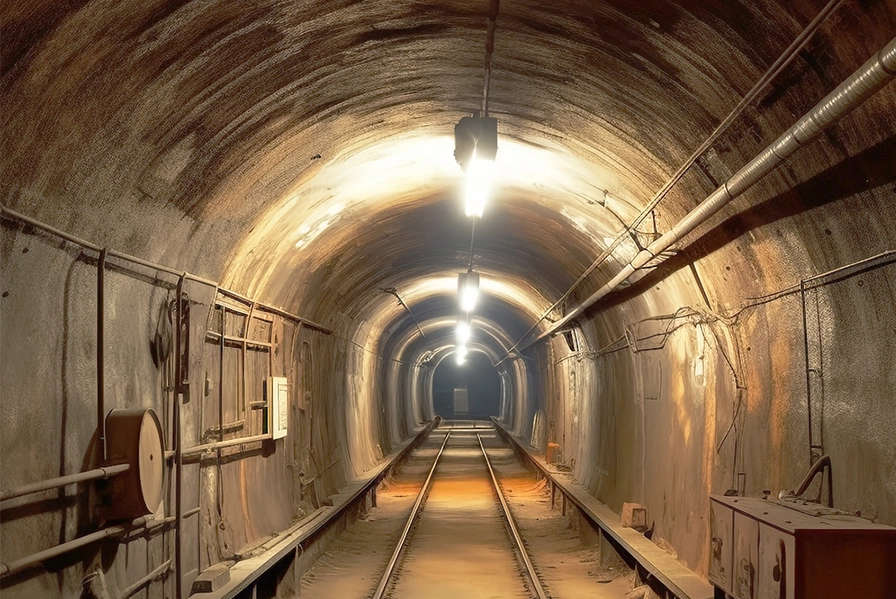
Multi-gas simultaneous measurement
Modular NDIR&ECD sensor, easy maintenance
Up to 8h of continuous operation with rechargeable li-battery

Highly selective TDLAS for<0.5% FS CH4 measurement
0-20 ppm H2S measurement range
Rapid results, no sample preparation, outperforms GC efficiency

Multi-gas measurement with SSL wall-mounted cabinet
Inbuilt air purging for extended H2S sensor lifetime
Thermostatic control, minimized temperature drift

Combined UV-DOAS, NDIR&ECD technology
Dual-Range H2S measurement
Real-time multi-gas monitoring with up to 4 sampling channels

Non-dispersive infrared (NDIR) is an infrared source-based technology. NDIR methane detection sensor consists of an infrared source, detector, optical filter, gas cell, and electronics for signal processing.
Methane gas detector working principle is based on the property of certain gas molecules to absorb light at specific wavelengths. Infrared light that is absorbed by a target gas passes through the active filter with a particular bandwidth for the detection of the target gas. The absorption of methane gas detection sensors is calculated according to the Beer-Lambert law. The amount of absorption is proportional to the concentration of the target gas.
Cubic NDIR methane sensor technology adopts the matrix calibration assuring excellent accuracy over the full temperature range; dual-beam optical path design and smart compensation algorithm ensure reliable long-term stability, achieving credible safety monitoring.
Tunable diode laser spectroscopy (TDLAS) is a narrowband laser-based technology. TDLAS methane detector mainly consists of a laser light source, gas chamber and photodiode.
The wavelength is tuned to the absorption optical spectrum of the target gas through periodic modulation of the input current. After targeted gas absorption, the remaining laser light will arrive at the photodiode which will be detected. The absorption is calculated according to the Beer-Lambert law. The amount of absorption relies on the optical path length in the gas chamber and the absorption coefficient of the target gas.
Cubic TDLAS technology adopts a long laser light path by multiple reflections, enabling low range, superior-low detection limit, and high-resolution quantitative measurement.
Ultraviolet Differential Optical Absorption Spectroscopy (UV-DOAS) is a broadband ultraviolet light-based technology. The UV light source, gas chamber, and spectrometer/photodetector comprise the primary components of a UV-DOAS sensor.
The broadband UV light passes through the sample gas, where specific wavelengths are absorbed by the target gas molecules. The spectrometer detects the transmitted light intensity across the spectrum after absorption. The Beer-Lambert law is employed to determine the absorption. The absorption coefficient of the target gas at specific wavelengths and the optical path length in the gas chamber determine the extent of absorption.
UV-DOAS technology utilizes a calibrated absorbance-concentration curve established via spectral analysis of the transmitted spectrum. This facilitates the real-time calculation of target gas concentration based on the measured absorbance, enabling simultaneous multi-component detection.

Contact Cubic Sensor to Explore Innovative Methane Gas Sensing Solutions!
 inquiry@gassensor.com.cn
 +86-27-81628827
 Fenghuang No.3 Road, Fenghuang Industrial Park, Eastlake Hi-tech Development Zone, Wuhan, 430205, China


 en
en fr
fr de
de es
es it
it tr
tr ru
ru nl
nl id
id